Market Newsletter
Week Ending August 28th, 2026
Market Recap
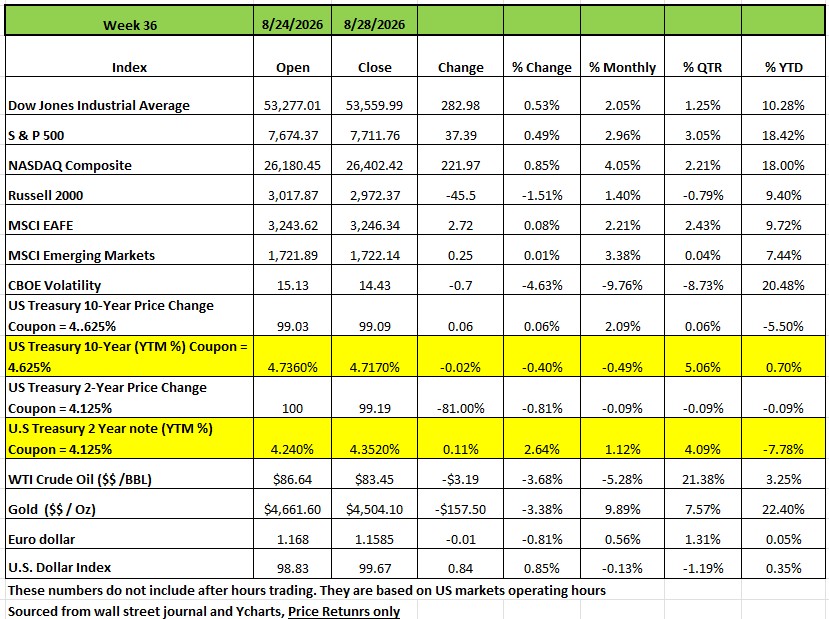
Global markets were relatively quiet this past week with most major macro asset classes modestly reversing some of the prior week’s sharper moves in a quiet consolidation. Three of the four of the major indices closed up last week, only the Russell 2000 posted a negative move on the week with a -1.51% decline. The S&P 500 index edged up 0.5% as did the DOW & the NASDAQ posted a 0.85% gain amid stronger-than-expected quarterly reports from tech companies including Salesforce (CRM) and CrowdStrike (CRWD).
At the annual Jackson Hole Economic Policy Symposium, Federal Reserve Chairman Kevin Warsh reaffirmed his commitment to the Fed's mandates, including the 2% inflation goal. Warsh said inflation numbers were concerning, citing the Fed's preferred metric -- the personal consumption expenditure price index -- which was unchanged at 3.7% year over year in July.
Data released earlier last week showed US economic growth, measured by gross domestic product, rose by 1.5% in Q2. This was unrevised from the advance estimate released in July and matched expectations in a survey compiled by Bloomberg.
The University of Michigan consumer sentiment index was revised upward on Friday to 51.7 for August from 51.0 in the preliminary estimate, compared with expectations for no revision in a survey compiled by Bloomberg. The latest reading was still below July's final print of 55.2.
Short-term yields spiked following Federal Reserve Chairman Kevin Warsh’s address from Jackson Hole on Friday, noting that inflation continues to run above the central bank’s 2% target and reaffirming his commitment to reining it in. The market implied probability of a September interest rate hike surged from 36% to 58% after his address, as traders digested a more hawkish tone from the Fed Chairman than anticipated. Earlier in the week, new single-family home sales declined 10.5% in July, and sales are now down 6.3% from a year ago. Real GDP growth in Q2 was unrevised at a 1.5% annual rate, matching consensus expectations. Corporate profits soared 9.1% in Q2, the largest increase in five years. Personal income rose 0.4% in July, beating the consensus expected +0.2% increase. New orders for durable goods rose 1.1% in July, beating the consensus expected 0.5% increase
By Sector
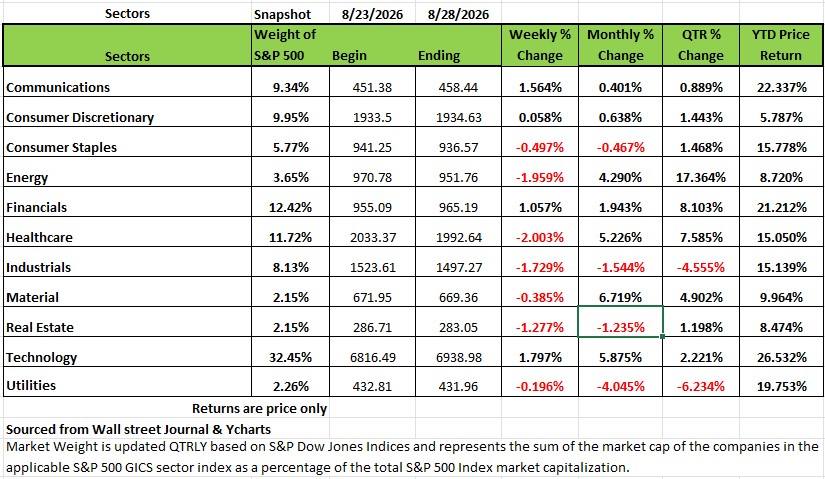
Seven of the 11 Sectors in the S&P 500 declined last week However the technology sector had the largest percentage increase, climbing 1.8%, followed by a 1.6% advance in communication services and a 1.05% rise in financials. Consumer discretionary eked out a 0.058% gain. Salesforce was the best performer in both the technology sector and the overall S&P 500 this week, jumping 22%. The company reported fiscal Q2 adjusted earnings and revenue above analysts' mean estimates and boosted its fiscal 2027 guidance.
CrowdStrike had the second-largest percentage gain in technology and the overall S&P 500, climbing 14%. The company reported better-than-expected fiscal second-quarter results. CrowdStrike also raised its guidance for full-year net new annual recurring revenue, or ARR, amid increasing demand for cybersecurity solutions to address artificial intelligence risks.
The health care and energy sectors fell -2.0% each, followed by a -1.7% decline in industrials and a -1.3% slip in real estate. Consumer staples, materials and utilities also edged lower.
Boston Scientific (BSX) had the largest percentage loss in health care for the week, shedding -7%. The company is recalling thousands of its percutaneous catheters due to possible arterial sheath tip separation that could lead to complications with a retained tip, the US Food and Drug Administration said.
The decline in energy came as crude oil futures also fell on the week. Mediators in the Iran war are stepping up efforts to get the Strait of Hormuz reopened, Reuters reported. Top decliners in the sector included EOG Resources (EOG), which fell 6.3% amid an investment rating downgrade by Capital One to equal weight from overweight.
Earnings reports next week are expected from companies including Palo Alto Networks (PANW), Dell Technologies (DELL), Medtronic (MDT), Broadcom (AVGO) and Snowflake (SNOW).
Investors will be heavily focused on the government's August employment report, due Friday. Other reports will include July construction spending and factory orders.
The Fed is Changing
And September May Make It Worse
What Warsh Said at Jackson Hole, What It Means for Rates, and Why the Calendar Is Working Against You Right Now
Two forces collided last week, giving investors more uncertainty than they bargained for heading into the fall. Federal Reserve Chairman Kevin Warsh used the most watched speech of his tenure at the Jackson Hole Economic Policy Symposium to deliver a blunt message about inflation — and markets heard it loud and clear. At the same time, the calendar flipped to September, the historically worst month for stocks in recorded market history.
Neither development is cause for panic. Both deserve to be understood clearly, because the combination — a potentially hawkish Fed meeting in two weeks layered on top of the market’s most reliably difficult month — creates a setup that rewards preparation and punishes complacency. Jackson Hole is the Fed’s annual opportunity to signal. Past chairs have used the Wyoming symposium to announce major policy pivots, frame new frameworks, and communicate direction to markets months in advance. Warsh used it differently.
Rather than offering the forward guidance that markets have come to expect — and that Warsh has explicitly criticized as a crutch — he delivered something more unsettling: clarity about the problem without clarity about the solution.
“While this summer’s readings were better than expected, they do not tell me that underlying trends have meaningfully improved.” — Fed Chair Kevin Warsh, Jackson Hole, August 28, 2026
The core message was threefold. First, PCE inflation at 3.7% — still nearly double the Fed’s 2% target — is “concerning” and must remain the central bank’s primary focus. Second, financial conditions are not broadly restrictive, a notable shift from his July press conference where he called them “uneven.” Third, and most consequentially for investors: short-term interest rates remain the Fed’s primary tool, and the Fed is prepared to raise them if inflation does not improve
The speech was carefully constructed to avoid a commitment that could box the Fed in — a deliberate choice Warsh has defended as avoiding the “hall of mirrors” problem where markets and the Fed simply validate each other’s expectations in a self-reinforcing loop. But the effect was the same as a hawkish signal: markets moved sharply to price in a rate hike
To understand why this speech rattled bond markets more than a straightforward rate signal might have, it helps to understand how Warsh’s approach differs fundamentally from his predecessors. Jerome Powell made forward guidance a central tool of Fed communication. Markets knew what conditions would trigger a rate move, could model the probabilities, and priced assets accordingly. It was a system that provided predictability — at the cost of occasionally boxed-in Fed decisions.
Warsh has rejected that model explicitly. “We should not indulge a regime in which market participants are looking primarily to the Fed for their next trade,” he said at Jackson Hole. His view is that forward guidance reduces the Fed’s ability to respond to changing data and creates a false sense of certainty that distorts asset pricing.
For investors, this doctrine has a direct and practical consequence: uncertainty is now a permanent feature of Fed policy, not a bug to be corrected. Every FOMC meeting becomes a live decision. Every inflation print becomes a potential pivot point. Portfolios built on the assumption that the Fed will telegraph its moves have a structural vulnerability that did not exist two years ago.
What the numbers say about September's Decision
The September Federal Open Market Committee meeting is scheduled for September 15–16. Two data releases will largely determine Warsh’s path before the gavel falls on interest rate hikes
August CPI will be released on Sept 11th and the August Jobs report will be released Sept 4th
Some institutions are bracing for another 50 basis point increase before the end of the year. Nomura Securities, a major Japanese financial services company, described Warsh’s remarks as signaling that “policy may need to react if disinflation is not occurring with speed”
The 10-year Treasury yield is already reflecting the recalibration, hovering around 4.78%. The 30-year Treasury yield has climbed back to just below 5.3%. These are not panic levels — but they represent a meaningful tightening of financial conditions that flows through to mortgage rates, business borrowing costs, and the discount rate used to value equities. All at a time when the Federal Debt exceeds $40 trillion, making the debt grow faster and investors demand more yield for the risk.
The Week Ahead
As we head into the last week of traditional summer ahead of the Labor Day weekend, once again the markets will have to wait until Friday for the main event, in this case the August Employment Report. After July’s surprising read, which showed a decline of 23k jobs, payrolls are expected to recover by a modest 56k with the unemployment rate holding steady at 4.1%. Although inflation has captured market attention, especially amid debate over whether one-time shocks from tariffs or energy prices could shift long-term expectations—employment remains the other side of the Fed’s dual mandate, as the Chair was careful to note. Friday’s report will shed some light on whether July’s decline was a one-off in an overall healthy labor market or the canary in the coal mine.
This article is provided by Gene Witt of Optimized Capital LLC (A wealth management advisory Firm) for general informational purposes only. This information is not considered to be an offer to buy or sell any securities or investments. Investing involves the risk of loss and investors should be prepared to bear potential losses. Investments should only be made after thorough review with your investment advisor, considering all factors including personal goals, needs and risk tolerance. Optimized Capital is a registered investment adviser that maintains a principal place of business in the State of Illinois. The Firm may only transact business in those states in which it is notice filed or qualifies for a corresponding exemption from such requirements. For information about Optimized Capital’s registration status and business operations, please consult the Firm’s Form ADV disclosure documents