Newsletter
Week Ending September 11th, 2026
Market Recap
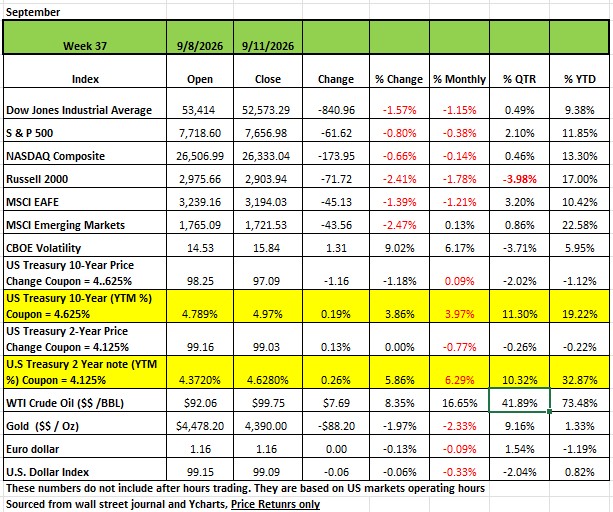
All four of the major indices were down last week, with the Russell 2000 slipping the most with a -2.41% decline, followed by the DJIA with a -1.57% decline. The S&P 500 index slipped -0.8% and the NASDAQ dropped - 0.66%this.
The S&P 500 ended the week at 7,656.98. This is the index's first weekly decline since the week ended Aug. 21. It's now down 0.4% for September but up almost 12% this year.
Data released Friday showed US consumer prices rose +0.4% month over month in August, the fastest pace since May and matching expectations. Core inflation, which excludes the more volatile food and energy components, jumped to a four-month high of +0.3%, exceeding market projections for an unchanged 0.2% growth.
Expectations for a rate increase at the Federal Reserve's next FOMC (Federal Open Market Committee) meeting, which is set for Tuesday of this week, rose after the inflation news. Bets for the US central bank to increase its benchmark lending rate by 25 basis points jumped to 87% Friday from 72% Thursday, according to the CME FedWatch tool.
US consumer sentiment survey showed a decline in September, while inflation expectations rose, with the year-ahead price growth outlook reaching the highest reading since June.
Treasury yields rose significantly during the week as ongoing military tensions in the Strait of Hormuz led to increased oil prices. Early in the week saw the largest exchange of tanker attacks between the U.S. and Iran so far and there were several explosions close to Iran’s Kharg Island, causing the price per barrel of oil to rise to over $102 on Thursday, before settling back down slightly on Friday. This was an overall increase of 9% over the course of the week. President Trump said that the war would end after the midterm elections, but a senior Iranian official said that Iran will escalate if the U.S. continues attacks. The increase in energy prices continued to fuel expectations for prolonged higher inflation, leading investors to believe that the Federal Reserve Bank would have to be more aggressive with rate hikes. On Wednesday, the Treasury Department said that it would purchase up to $6 billion of longer-term government debt, and it only purchased $5.19 billion on Thursday, which seemed to be lower than expected as yields rose significantly and the 10year Treasury yield hit its highest point since 2023. On Friday, CPI was reported in line with expectations, slightly easing concerns for inflation. The market implied probability of a 25-basis-point increase to the Federal Funds Rate at the September 16th meeting rose from 62% to 88% during the week, while the market implied rate for June 2027 rose 30 basis points from 4.21 to 4.51.
By Sector
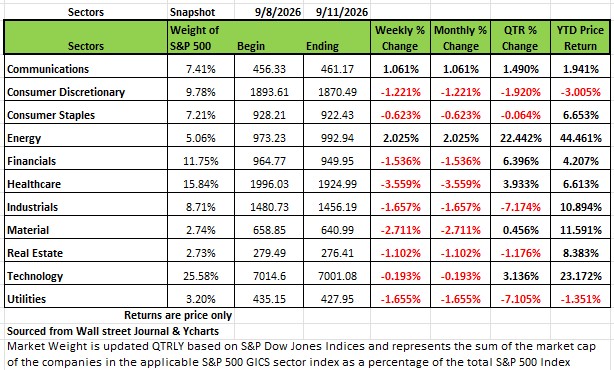
By sector, Communications and Energy were the only two sectors to post a positive gain last week. On the downside, Healthcare had the largest percentage drop of the week, falling -3.6%, followed by a -2.7% decline in materials. Industrials and utilities shed -1.7% each, financials fell -1.5%, consumer discretionary declined -1.2%, and real estate slipped -1.1%. Consumer staples and technology also edged lower.
Cooper (COO) led the decliners in Healthcare and also had the largest percentage drop in the overall S&P 500 for the week, tumbling -23% amid weaker-than-expected fiscal Q3 sales. The company, which produces vision products and surgical-related devices, also lowered its full-year outlook.
Corteva (CTVA) was among the decliners in the materials sector, slipping -4.5%. Chemours (CC), DuPont de Nemours (DD) and Corteva said they have agreed to a $455 million settlement with North Carolina and 11 local entities to resolve PFAS-related claims. Shares of Chemours and DuPont also declined on the week.
The energy sector's advance came as crude oil futures rose on the week. The White House is mulling ways it can use the Defense Production Act to expand US oil refining capacity, Reuters reported, citing two sources familiar with the plans. Saudi Arabia's Energy Ministry said on Friday its East-West pipeline was shut after multiple attacks, according to media reports.
The energy sector's top gainers included Valero Energy (VLO), which rose +5.3%, and APA (APA), which climbed +4.6%.
All eyes this week will be on the two-day FOMC meeting set to conclude on Wednesday. Economic data will include August Retail Sales, pending home sales, industrial production, and capacity utilization.
The Fed’s Tough Decision
The Federal Open Market Committee (FOMC) meets this week as policymakers weigh difficult economic trade-offs. Commentators, analysts, and prediction markets generally expect the Fed to raise interest rates. While an increase could help curb inflation, it could also further strain other areas of the economy, especially housing. Mortgage rates do not look like they will be going down anytime soon, and this will mean home buyers will need to adapt by either buying smaller homes or postponing the purchase longer. We have been conditioned for more than a decade to believe that interest rates should be lower but historically, the rates are where they have been. Can we adapt again?
Right now, many companies are doing well and posting better-than-expected earnings, but that doesn’t mean that smaller private companies are in the same boat. Smaller businesses are more sensitive to changes in interest rates; currently, they are paying higher wages just to get workers, and while business owners seem to have a favorable outlook, any change in revenue and profitability may result in a reduction of labor.
It appears that there are 3 parts to the Fed’s interest rate dilemma: first and foremost is the economy, the FOMC itself, and then the credibility of the Fed.
As the conflict with Iran continues, so are the rising prices of oil and inflation. Transportation costs for businesses have increased, and that is being passed along to the consumer; just look at how some food products have risen. While the U.S is now a net exporter of oil, keep in mind that the market sets prices. There also seems to be a debate about just how much crude is able to slip through the Strait of Hormuz, but regardless, the traffic is down considerably. Saudi Arabia has shut down a key pipeline in response to Houthis attacks. The price of WTI Crude is now up +41.8% this quarter and over +73% YTD. Iran is quite aware of the upcoming midterm elections, and this means that they have little incentive to negotiate; they would favor a change in our government since this would limit the President’s ability to continue his agenda. It’s also worth noting that oil price surges are more of a temporary supply shock than a permanent one, and it’s a good bet that oil flows after the midterm elections will go back to normal. Will voters realize this?
Another position for the rate increase is the jobs report, which came in with +162K in August with unemployment down to 4.1% the Atlanta Fed is projecting GDPNOW model at +4.4% pace for Q3. This is a combination of both inflation and production output from Data center development. While unemployment remains low much of this is because of immigration restrictions and retiring baby boomers, who have reduced the labor force by 973K over the past year, so the workforce is smaller. But we still have a challenge with younger workers under 30, finding the jobs and salaries they want. One additional concern is that wage growth has just barely kept pace with inflation the August number was 3.1%
The second concern for an interest rate increase is the members of the Fed. There are 18 participants, eight who have said that they do not want a change in rates for the remainder of the year. One wants a cut in rates, 3 members want one rate hike, five members favor 2 rate hikes, and one wants 3 hikes. However, of the 18 members, only 11 will have a vote this year. So, the question now is whether Warsh will do something that basically got his predecessor fired.
The last issue is the credibility of the Fed. In congressional testimony a few months ago, Warsh insisted that the FOMC will have no tolerance for inflation and has sworn to make this a priority. However, the issue with the markets is that it has been conditioned for the last decade and a half that the Fed will give guidance. Without guidance, the markets are left to make assumptions based on what information they have.
Consumers have also been conditioned to want everything: lower interest rates and lower inflation. We pretty much lived in this environment between the 2008 Financial crisis and the pandemic. Most Americans do not correlate the two. So what will the Fed do? After a slightly hot August core CPI reading on Friday, bringing the 12-month comparison to last August CPI at +3.4%, Fed funds futures now price a 92% chance of a rate hike this week and have fully price a second by year-end and a third by March 2027. Just look at the Bonds market: over the six weeks since the last meeting, the 10-year Treasury yield has climbed from 4.67% to 4.96%. In the absence of guidance, market thinking has settled on a hike — and if the Fed fails to deliver, both Warsh and the FOMC could lose credibility.
In conclusion, the market's immediate test is not whether equities can absorb one more policy event, but whether demand can absorb restrictive policy and higher energy costs at the same time.
The Week Ahead
Investors will be focused on the FOMC’s 2-day meeting, which concludes on Wednesday, with the Fed Funds futures market now pricing in an 85% probability of a 25-basis-point hike in the Fed Funds target rate. With $100 crude oil, longer-dated Treasuries at multi-year highs and inflation remaining above the Fed’s stated 2% target rate, markets are now concerned that the Fed’s job might not be complete with a one-and-done hike but rather may be forced into a tightening cycle. In fact, Fed Funds futures reflect only a 25% probability that rates are only 25 bps higher than the current target by year-end. Other central banks will also have rate decisions to make, with the Bank of England expected to hold rates steady on Thursday while the Bank of Japan is widely expected to hike rates by 25 bps on Friday, perhaps confirming the “asymmetric information” U.S. Treasury Secretary Bessent alluded to after undertaking the coordinated intervention to support the Yen. All things considered, U.S. equities, still buoyed by robust earnings, have shown remarkable resilience, acting like an inflatable ball pressed beneath the water’s surface in response to adverse macro influences, while shooting higher whenever the pressure is removed.
This article is provided by Gene Witt of Optimized Capital LLC (A Registered Investment Advisory Firm) for general informational purposes only. This information is not considered to be an offer to buy or sell any securities or investments. It is not to be considered as investment advice. Investing involves the risk of loss, and investors should be prepared to bear potential losses. Investments should only be made after thorough review with your investment advisor, considering all factors including personal goals, needs, and risk tolerance. Optimized Capital is a registered investment adviser that maintains a principal place of business in the State of Indiana. The Firm may only transact business in those states in which it is notice filed or qualifies for a corresponding exemption from such requirements. For information about Optimized Capital’s registration status and business operations, please consult the Firm’s Form ADV disclosure documents.
#FinancialAdvisor, #investmentmanagement #wealthmanagement #financialplanning #retirementplanning #401kplans