WEEKLY MARKET & ECONOMIC COMMENTARY
Week Ending Nov 6th, 2026
Market Recap
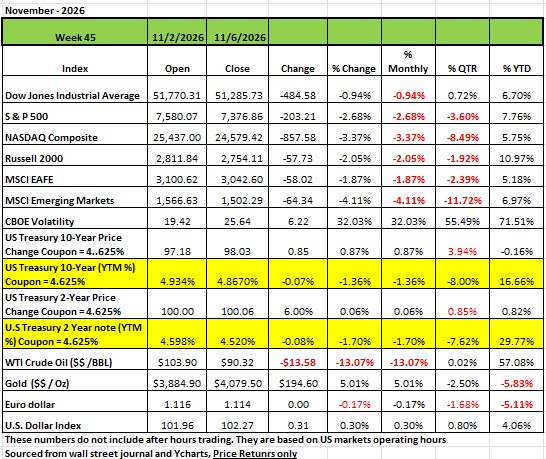
Last week proved to be extremely volatile after the mid-term elections, as Democrats took control of both the House and Senate. Markets responded favorably on Wednesday, with the S&P 500 jumping 1.5%. However, markets did a 180-degree turn on Thursday, declining -4.3% in one day, ending the week with a -2.68% decline. The market benchmark is now down -3.6% for the fourth quarter and up 7.8% this year.
The rest of the indices declined as follows: DJIA -0.94%, NASDAQ -3.37%, and the Russell 2000 -2.05%.
The sizable swing in the political pendulum is being driven by inflation, tariffs, the Iranian conflict, and energy cost, which in part is also including utility bills from local providers. Today’s inflation report came in hotter than expected +0.4% on a MoM basis and +3.7% YoY.
Technology stocks also slid in the aftermath of the election. A Democratic Congress is likely to bring greater scrutiny on technology and artificial intelligence spending
Data later in the week showed the US economy had more than twice as many October job gains as expected by Wall Street. This boosted expectations for a Federal Reserve interest rate increase next month.
Treasury yields ended the week lower as money moved more toward safety. Several Republican strongholds, including Texas, Kansas, Ohio, and South Carolina, were flipped as Democrat candidates pulled off surprising upsets. Treasuries surged as the results sparked a selloff in technology stocks on concerns that the shift in political power will result in more regulations, data center restrictions, and a slower rollout of AI infrastructure.
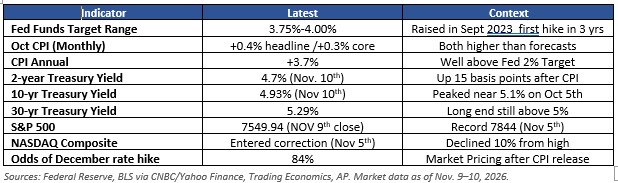
Friday’s jobs report pushed yields higher, as nonfarm payrolls increased by 165,000 in October, easily beating the consensus expected gain of 70,000. The stronger-than-expected jobs report increased bets on another rate hike at the December 9th policy meeting, as the market implied probability of another rate increase now stands at 84%
By Sector
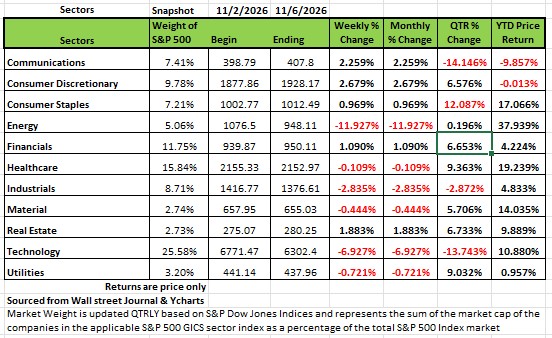
Six of the 11 sectors in the S&P 500 posted a negative return on the week, with Energy shedding -12% last week, followed by a -6.9% drop in technology and a -2.8% loss in industrials. Utilities, materials, and health care also edged lower. Devon Energy (DVN) had the largest percentage drop in the energy sector for the week, falling -19%. The company reported Q3 adjusted earnings per share and revenue above analysts' mean estimates. Still, the company's shares fell amid the drop in crude futures, and as shareholder TOMS Capital Investment Management said it was "profoundly disappointed" that Devon decided not to sell additional assets after finishing its strategic review.
Lumentum (LITE) and Marvell Technology (MRVL) were among the top decliners in the technology sector as well as the overall S&P 500, sliding -36% and -28%, respectively, amid an all-stock deal between the companies. Under the agreement, the companies aim to combine Marvell's custom silicon chip technologies with Lumentum's optical components and specialized semiconductor manufacturing capabilities to create a leader in artificial intelligence connectivity.
On the upside, consumer discretionary rose +2.7%, followed by a +2.3% increase in communication services; however, the sector is still down -14% on the quarter and 9.8% YTD. Real Estate saw a rise of +1.9%. Financials and consumer staples also rose slightly.
Airbnb (ABNB) led the gainers in consumer discretionary, climbing +16%. The company reported higher-than-expected third-quarter results that included its fastest revenue growth in more than three years. Airbnb also forecast Q4 revenue above the Street's view and increased its full-year revenue guidance.
Earnings reports this week are expected from companies including Cisco Systems (CSCO), Applied Materials (AMAT), KKR (KKR), Constellation Energy (CEG), Occidental Petroleum (OXY), and Take-Two Interactive Software (TTWO)
The Bond Market Is Talking. The Stock Market Isn’t Listening
A divided Congress, Nvidia’s China problem, and a Fed that is raising rates again — and what all three mean for 2027.
In the span of one week, investors absorbed a wave election, the worst single day for technology stocks in years, a scandal at the most important company in the AI trade, and a hotter-than-expected inflation report. The S&P 500 is only about 4% below its October 6 record as of Monday’s close. That calm headline number hides a lot.
Our view is simple: the stock market is still priced as if the AI spending boom will continue on schedule and interest rates will stop rising. The bond market has already stopped believing the second half of that sentence. 2027 is likely to be the year one of them is proven wrong.
The Election: What Changed, and What Didn’t
The Democrats won control of both the House and the Senate last week ending Republican control for the final two years of the President term. Exit polls pointed to the same issue that has dominated the last two election cycles: cost of living. Most voters again described inflation as a hardship.
The market’s first reaction was relief. The Dow rose about 1,570 points (3%) on November 4 as uncertainty cleared. Health care and discount retail rallied sharply. The second reaction, on November 5, was very different: the Nasdaq fell -5.5%, its worst day in roughly a year and a half, as investors worried
that new majorities — including in Texas, a center of data-center construction — would bring slower permitting and more scrutiny of AI spending.
Our read, without taking sides: divided government historically means gridlock, and gridlock cuts both ways. Major new spending programs become harder to pass, but so do new tax cuts. For a bond market that is already nervous about a federal interest bill approaching $1 trillion a year, less fiscal activity is not necessarily bad news. The bigger shift for investors is oversight: committee investigations, hearings and regulatory pressure on specific industries. That risk is concentrated, not broad.
History may offer mild comfort. Stocks have averaged roughly a +12% gain in the twelve months after midterm elections. But the specific combination we now have — a Republican president with a Democratic Congress — has historically produced below-average returns in the first three months. Keep in mind that neither statistic is a forecast, just history. The economic and valuation backdrop matters far more than which party holds the gavel.
2. Nvidia: China Moves From Footnote to Headline
Over the weekend, Nvidia CEO Jensen Huang acknowledged an extramarital relationship with a former executive of Mega speed, a Singapore-based cloud company. U.S. intelligence agencies reportedly believe she was passing information to Beijing, and Mega speed has separately faced allegations that it helped move restricted Nvidia chips into China. Nvidia’s board has opened an independent investigation and says it has no initial reason to believe trade secrets were compromised. The stock fell more than -4% Monday and is now negative for the year.
The personal side of the story is not what matters for investors. Two business questions are:
China exposure. New Street Research estimates up to 10% of Nvidia’s expected fiscal 2027 revenue — roughly $37 to $47 billion — is tied directly or indirectly to China, including sales booked elsewhere that end up serving Chinese users. If Washington tightens enforcement, that revenue is at risk.
Key-person and political risk. House Democratic Leader Hakeem Jeffries has already said Congress will need a full briefing. A new majority with investigative power, a CEO under review, and new competing AI chips from Alphabet arriving the same day is a lot of uncertainty for a company the market had priced for near-perfect execution.
Why this matters beyond one stock: Nvidia’s revenue is, in effect, the hyperscalers’ capital spending. It is the clearest single read on whether the AI buildout stays on schedule. It is also notable that, for the first time since late 2022, analysts expect quarterly earnings growth from the Magnificent Seven to trail the other 493 companies in the S&P 500. Leadership is already narrowing.
“Nvidia’s revenue is the hyperscalers’ capital spending. When the bellwether wobbles, the whole AI chain feels it.”
3. Rates and Inflation: The Market That Is Paying Attention
It is fair to say the stock market has not been concerned about interest rates. The bond market has been very concerned. The 10-year Treasury yield climbed from 5.00% in mid-September to about 5.31% in early October, and most of that move came from higher real yields — the return investors demand after inflation — rather than higher inflation expectations. That is the bond market asking to be paid more for lending long term. Yields eased last week as investors fled to safety during the tech selloff, but they jumped again this morning.
The Federal Reserve has shifted, too. After three cuts in late 2025, it raised rates in September for the first time since 2023, then held in October with two officials voting for another hike. Today’s October CPI report (headline +0.4%, core +0.3%) came in above forecasts. Fed Governor Christopher Waller said this morning that a core reading of 0.3% or higher could justify a half-point hike in December, and that the Fed should at minimum take back the “insurance” cuts from last year. Traders now put the odds of a December hike near 84%. The Fed’s own projections show no rate cuts in 2027.
Plain-language translation: the era of “the Fed will cut and rescue valuations” is over for now. Rates are rising because inflation is showing up in services that have nothing to do with tariffs or energy. That kind of inflation tends to be sticky.
Rising rates matter to stocks in two ways. First, they raise the discount rate — the rate used to value future profits in today’s dollars — which hits long-dated growth stories hardest. Second, they raise the cost of the AI buildout itself. Morgan Stanley estimates that roughly half of 2027 AI compute spending will be financed with debt and leases, so every increase in borrowing costs makes those projects harder to justify.
4. The Valuation Math: What Investors Are Actually Paying
Whether this market is “overpriced” depends on which yardstick you use — and the gap between the yardsticks is the story.
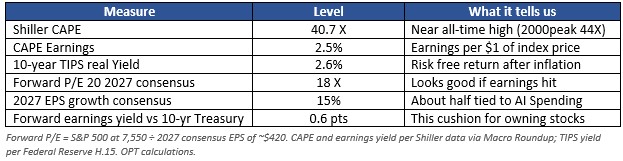
Here is the uncomfortable comparison. Using the Shiller CAPE, which averages the last ten years of inflation-adjusted earnings, the S&P 500 offers an earnings yield of about 2.5%. A 10-year inflation-protected Treasury pays about 2.6% after inflation, with no credit risk if held to maturity. On that measure, investors are accepting essentially no extra compensation for owning stocks, a gap known as the equity risk premium, and one last seen this thin in the late 1990s. To be fair, CAPE understates today’s earning power after a decade of strong profit growth. On next year’s expected earnings, the premium widens to roughly 3 points. But that more comfortable number only holds if 2027 earnings arrive as forecasted, and as we explain below, those forecasts rest heavily on AI spending continuing to accelerate
The forward P/E of about 18 times looks reasonable only because analysts expect roughly 15% earnings growth in 2027. That growth is heavily dependent on one assumption: that hyper-scaler capital spending rises from roughly $800 billion this year to $1.1–1.2 trillion next year. One company’s spending is its suppliers’ revenue. Goldman Sachs estimates that if 2027 capex simply stays flat at this year’s level, S&P 500 earnings growth falls to about 1%. Capex does not need to collapse to hurt earnings; it only needs to stop growing.
“The forward P/E only looks normal if the AI spending boom keeps accelerating. Capex doesn’t have to fall to hurt earnings — it just has to stop growing.”
Meanwhile, the revenue needed to justify that spending has not yet arrived. Goldman estimates the hyper-scalers need roughly $300 billion a year in AI revenue just to break even on their 2026–27 spending, and current estimates remain below that level, though they are climbing quickly.
5. What 2027 Could Look Like
Rather than offer a single price target, we ran the simple math: index level equals earnings times the multiple investors are willing to pay. We changed only the two variables that matter most — AI capex growth (which drives earnings) and interest rates (which drive the multiple).
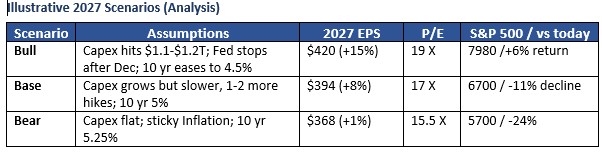
The key takeaway is the asymmetry. Even if everything goes right — AI spending accelerates on schedule and rates stabilize — the upside is modest, because much of that outcome is already in the price. If either assumption slips, the downside is a multiple of the upside. That is what an expensive market looks like: not a guaranteed decline, but a poor trade-off between what you can gain and what you can lose.
The most likely path in our view is not a crash but a grind: a year in which index returns are flat to negative while leadership continues to rotate away from the most expensive AI names toward companies that generate cash today. We have already seen this begin — semiconductor stocks fell roughly -15% in October while defensive sectors and small caps held up better.
6. What We’re Watching and How We’re Thinking About It
December 9 Fed decision. A 25-point hike is priced in. A 50-point hike, or a signal of more in 2027, would test equity valuations directly.
The 10-year at 5%. Each time it has pushed above 5% this fall, long-duration growth stocks have struggled. Watch the real yield, not just the headline.
Hyperscaler 2027 capex guidance. January and February earnings calls will tell us whether spending is still accelerating. This is the single most important number for 2027 S&P earnings.
Nvidia’s investigation and any export-control response. The question is not the headline — it is whether China-linked revenue is restricted.
Congressional oversight when the new session begins in January. Hearings on AI, data centers, energy and health care could move individual sectors sharply.
For our clients, this environment reinforces how we already invest. We do not believe markets are efficient, and we do not believe you are paid simply for owning the index at any price. When the index offers almost no premium over an inflation-protected Treasury, every dollar has to earn its place. That means favoring businesses with real free cash flow today over those whose valuations depend on spending that has not yet produced a return, being deliberate about bond maturities while yields remain elevated, and keeping enough flexibility to act when prices become attractive rather than after.
Volatility like last week’s is uncomfortable, but it is also where opportunity comes from. Our job is to make sure that when it arrives, you are positioned to take advantage of it rather than react to it.
Sources
Election: CBS News, CNBC, AP, U.S. Bank Asset Management (midterm market history). Nvidia: CNBC, Yahoo Finance, New Street Research (via CNBC), FactSet (via The Tech Trader). Rates & inflation: Federal Reserve (H.15, FOMC statements, Sept. 2026 SEP), BLS October CPI (via CNBC, Yahoo Finance), Gov. Waller remarks (via TheStreet). Valuation & capex: Goldman Sachs Research (Sept. 2026), Morgan Stanley (via Crypto Briefing), Shiller CAPE (via Macro Roundup), consensus EPS (Aranca).
The Week Ahead
Investors are entering the week looking for signs indicating whether the recent technology selloff represents a reset in valuations or a more fundamental reassessment of the economics of the AI investment cycle. Earnings from CoreWeave on Tuesday, followed by Cisco and Applied Materials on Thursday, should provide important signals about the health of the AI infrastructure cycle.
CoreWeave will be particularly important, given its exposure to the financing concerns surrounding the neo-cloud business model, while Cisco and Applied Materials should offer insight into demand for networking equipment and semiconductor manufacturing technology. Investors have increasingly been focused on the important distinction between the hyper scalers and the neo-cloud providers. Microsoft, Amazon, Alphabet, and Meta have substantial cash flows, diversified businesses, and relatively easy access to debt markets that can finance their infrastructure spending. The neo-clouds, by contrast, are far more dependent on lenders’ ongoing willingness to extend credit, and investors are growing increasingly concerned about these companies’ ability to handle their debt loads. The economic calendar also brings two important inflation readings, with CPI on Tuesday and PPI on Friday. Beyond the scheduled data and earnings releases, investors will continue to monitor developments in the Middle East and the potential implications for energy prices and inflation.
Wednesday is Veterans Day, a federal and banking system holiday although U.S. equity markets will remain open. Thanks to all who have served our country in the armed forces
Important Disclosures
This commentary is provided by Optimized Capital for informational and educational purposes only and does not constitute investment, tax, or legal advice, or a recommendation to buy or sell any security. Opinions expressed are as of the date of publication and are subject to change without notice. Information has been obtained from sources believed to be reliable, but its accuracy and completeness are not guaranteed. Valuation figures are approximate and may change materially following the earnings reports discussed. Past performance is not indicative of future results. All investing involves risk, including the possible loss of principal. Please consult your advisor regarding your individual circumstances.
#FinancialAdvisor, #investmentmanagement #wealthmanagement #financialplanning #retirementplanning #401kplans