WEEKLY MARKET & ECONOMIC COMMENTARY
Week Ending November 13th, 2026
Market Recap
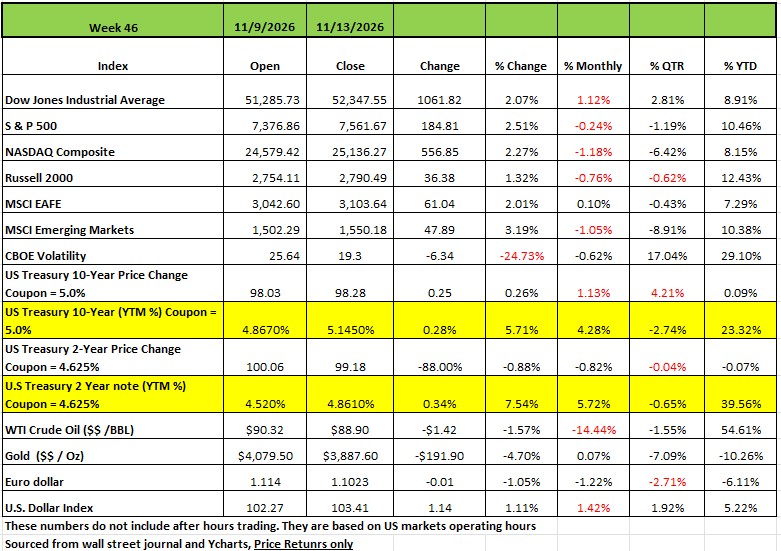
Last week was a bit on the crazy side, as headlines about NVIDIA led every financial news story for the week. NVDA declined over -12% on the week and is down -20.4% month to date. However, even with the largest company declining so much, all of the indices were up, with the S&P 500 posting a +2.5% gain followed by the NASDAQ +2.27%, THE DJIA + 2.07% and the Russell 2000 +1.32% The Standard & Poor's 500 index rose in a broad advance led by the energy sector despite turmoil in chip stocks.
Data released this week showed the consumer price growth slowed in October but still exceeded Wall Street's projections, boosting expectations that the Federal Reserve will raise interest rates in December. US producer prices rose less than expected in October on a monthly basis, but annual growth hit the highest level in nearly four years amid surging energy costs.
Treasury yields rose sharply across the board this week as hot inflation data and hawkish Fed comments left a December rate hike all but certain. October consumer prices rose +0.4% (versus the 0.3% forecast), lifting the year-ago comparison to +4.1%. Energy led the way, up +0.7% on the month and 21.5% on the year, while food rose +0.5%, its biggest jump in six months, to +3.0% annually. Core CPI, which strips out food and energy, rose +0.3% for the third straight month and is up +2.8% from a year ago. October existing home sales fell to their lowest level since 2010 as mortgage rates, which track Treasury yields, kept buyers on the sidelines. The 30-year mortgage rate hit 7.5% in October and has been hovering around its highest level since 2000. Activity has been stuck in low gear near a 4.0 million annual pace since the pandemic, similar to the post-financial-crisis period and well below the roughly 5.25 million pre-COVID norm (and 6.5 million during COVID). Affordability is the main problem, and it has worsened as global conflicts push up energy costs and short-term inflation. October producer prices rose 0.3%, lifting the annual rate to 6.5%, the highest in almost four years, and nothing in the report is likely to deter a December Fed hike. Goods prices rose 0.5% and are up 10.2% on the year, with core goods accounting for more than 60% of the monthly increase.
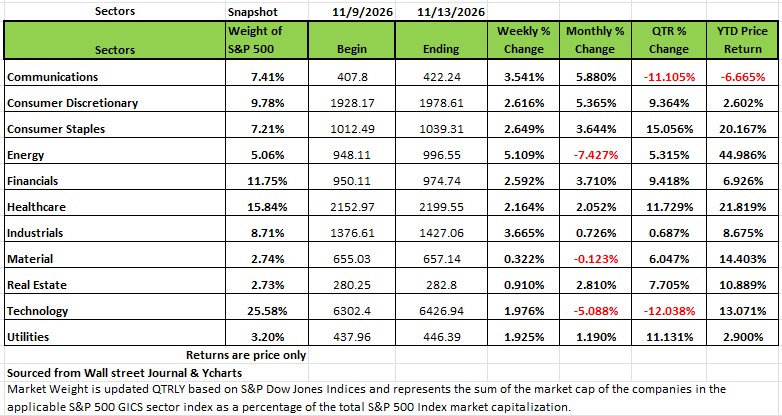
By Sector
All of the S&P 500's 11 sectors rose this week. Energy had the largest percentage gain, climbing +5.1%, followed by a +3.7% rise in industrials and a +3.5% advance in communication services. Consumer discretionary, consumer staples, financials and health care were also strong, rising more than +2% each. The materials sector had the smallest gain, edging up just +0.3%.
The energy sector's advance came as natural gas futures rose on expectations for cold weather to boost near-term heating demand.
Targa Resources (TRGP) was the best performer in the energy sector, climbing +12% on the week. Analysts at Scotiabank and Morgan Stanley boosted their price targets on the stock.
Bloom Energy (BE) was among the top gainers in the industrials sector, rising +11%. Noting that the US midterm election results showed increased opposition toward data centers and calls for increased oversight, RBC Capital said in a note to clients: "Inevitably this slows the pace of development, and the near-term uncertainty is a headwind, but BE remains in a relatively favorable position."
In communication services, Charter Communications (CHTR) was the top performer, jumping +17%. The company's subsidiaries launched eight cash tender offers to buy back up to $1.5 billion in notes.
However, chip stocks were weighed down by trouble at the top of NVIDIA (NVDA), where Jensen Huang resigned his role as chief executive following revelations of affairs that included an alleged Chinese spy. Huang was asked to voluntarily testify before the US Senate Banking Committee on Dec. 3, according to a Nov. 12 letter by the Committee Chair, Tim Scott, posted on X on Friday.
NVIDIA will remain in focus this week as the company is scheduled to release its quarterly results.
Other companies on next week's earnings schedule include Home Depot (HD), Walt Disney (DIS), Palo Alto Networks (PANW), TJX (TJX), Lowe's (LOW), Target (TGT), Walmart (WMT), Intuit (INTU), and BJ's Wholesale Club Holdings (BJ).
Economic data will include October retail sales, housing starts, industrial production, and capacity utilization.
The Fed Has Turned the Wheel
Markets started 2026 expecting rate cuts. They are ending it bracing for a second hike,
and the Fed will make that call without its usual view of inflation.
In January, the consensus on Wall Street was that 2026 would bring lower interest rates. With six weeks left in the year, the Federal Reserve is getting ready to raise them for the second time. On September 16, the Fed lifted its benchmark rate by a quarter point to a range of 3.75% to 4.00%. It was the first increase since July 2023 and the first rate move under Chair Kevin Warsh, and the vote was unanimous. The Fed held steady in October, but the data since then has made another move close to certain. After last week's inflation reports, futures markets fully price a second quarter-point hike at the December 8–9 meeting, and some Fed officials have openly floated a half-point move.
What Changed
Three things changed. Consumer prices kept rising faster than expected, wholesale costs accelerated, and the job market didn't cool.
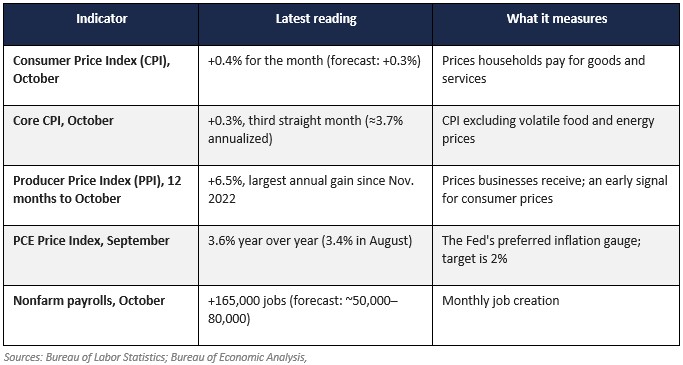
A quick word on annualized: a 0.3% monthly rise sounds small, but three months in a row at that pace works out to roughly 3.7% a year. That is close to double the Fed's 2% target. Chicago Fed President Austan Goolsbee called the latest data “borderline disturbing.” Food and shelter led the increase in consumer prices.
On the wholesale side, freight trucking costs jumped 3.9% in October alone. Trucking is a cost that eventually shows up in the price of almost everything that travels by road.
Driving With a Foggy Windshield
This time there's an unusual complication. Last fall's government shutdown stopped price collection in October 2025, so the Bureau of Labor Statistics can't publish a 12-month inflation rate for October 2026. There is no year-earlier number to compare against. The annual figure returns with November's data on December 10, one day after the Fed announces its decision. The committee will set policy from monthly readings and statistical estimates, without the headline number most Americans recognize.
The Fed will make its December decision one day before it sees November's inflation report.
That raises the stakes for what Chair Warsh says at the December press conference. A hike described as a single adjustment would land very differently from one presented as the start of a series. Dallas Fed President Lorie Logan has already said she sees at least two more quarter-point increases before a pause. Minutes from the October meeting, due Wednesday, are the next clue to how widely that view is shared.
What It Means for Business Owners and Investors
Fed decisions reach Main Street faster than most people expect:
Variable-rate debt. Most business lines of credit are priced off the prime rate, which is conventionally set three percentage points above the top of the Fed's range and moves with it. If your credit line floats, budget now for the higher cost.
Real estate and equipment. Thirty-year mortgage rates are near 7.18%. The 10-year Treasury yield, which anchors most long-term borrowing, recently traded around 4.84%. Any refinancing or expansion plan built on early-2026 rate assumptions needs a fresh look.
Cash. There is an upside. Treasury bill and money-market yields rise with the Fed, so operating cash parked in a low-yield account costs you more every month it sits there.
Bonds. Higher yields mean more income on new purchases, but they push down the prices of longer-dated bonds you already own. Duration, a bond's sensitivity to rate changes, matters more now than at any point since 2023.
Stocks. Higher rates raise the bar for richly valued growth stocks, because their future earnings are discounted at a higher rate. That helps explain this month's swings in AI and chip shares: the S&P 500 fell 4.4% in a single day in early November before recovering.
Keeping It in Perspective
Rate hikes don't automatically lead to recession. Several of the Fed's completed tightening cycles since 1971 ended without one, including 1983–84 and 1994–95. In the 1994–95 cycle, the Fed doubled its target rate from 3% to 6% and the economy kept growing. What has tended to matter is whether the Fed acts before inflation becomes entrenched in wage and price expectations.
The bottom line: Rates are heading up, not down, and the Fed's own projections from September showed no cuts through 2027. There's no reason for alarm yet, but it is a reason to review your finances. Know which of your liabilities float, put idle cash to work, and be selective about paying up for growth. Getting the best return on every dollar means planning around the rate environment. Higher rates will put a strain on smaller businesses just to cover cash flow needs on receivables. If unemployment rises, there's a good chance markets will sell off, because 47% of 401K plan accounts will be cashed out. Also If foreclosures increase, it will be a signal to move to cash quickly.
Side Bar
Key-Person Risk: What Nvidia Teaches Every Business Owner
With the resignation of Nvidia's CEO Jensen Huang last week, we felt it important to mention the necessity of a succession plan to our readers
Jensen Huang had run the company for 33 years; he built it from the ground up with two partners, Chris A. Malachowsky, currently senior VP of engineering and operations, and Curtis Priem, retired. CFO Colette Kress, who has been at Nvidia since 2013, is serving as interim CEO while remaining as CFO. Longtime director Harvey Jones, who became the company's first-ever board chair will consider internal and external candidates with the board for the permanent role.
Wall Street responded to the situation with downgrades, and the stock fell. Tuesday's earnings report, with consensus estimates of about $2.47 per share on $108.8 billion in revenue, will be the first since Huang's exit. This quarter, investors will be listening less to the numbers than to what management and customers say about continuity.
The lesson reaches well beyond Silicon Valley. If one person's sudden exit can jolt the world's most valuable chipmaker, it can jolt a professional practice or a family-owned manufacturer just as easily. Four questions worth asking this week:
Is there a named successor, and does that person know your key clients?
Is your buy-sell agreement current, and is it funded?
Does your key-person insurance reflect what the business is worth today?
Could the business run for 90 days without you?
Nvidia had a deep bench and a CFO the market already knew. Most private companies have neither. The old saying " Expect the best, but prepare for the worst' is never more accurate than now, while most of our readers are not running Fortune 500 companies. The consequences are usually a lot more painful for family-run businesses for not having a plan in place.
This article is provided by Gene Witt of Optimized Capital LLC. for general informational purposes only. It is an opinion, not investment advice. This information is not considered to be an offer to buy or sell any securities or investments and again not to be considered investment advice. Investing involves the risk of loss and investors should be prepared to bear potential losses. Investments should only be made after thorough review with your investment advisor, considering all factors including personal goals, needs and risk tolerance. Optimized Capital Registered Investment Adviser (RIA) that maintains a principal place of business in the State of Illinois and Indiana. The Firm may only transact business in those states in which it is notice filed or qualifies for a corresponding exemption from such requirements.
#FinancialAdvisor, #investmentmanagement #wealthmanagement #financialplanning #retirementplanning #401kplans