WEEKLY MARKET & ECONOMIC COMMENTARY
Week Ending October 2nd, 2026
Market Recap
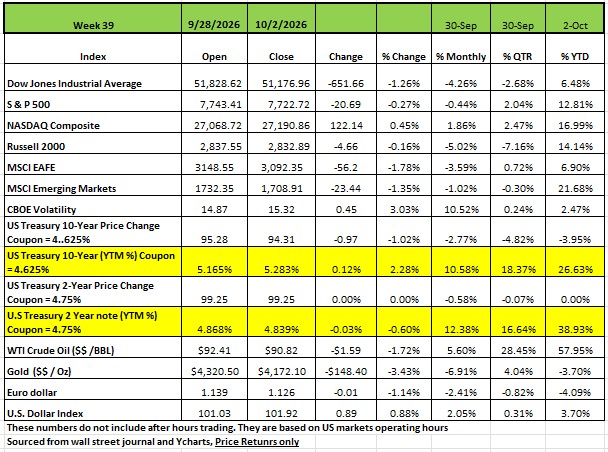
Last week marked the end of the month as well as Q3. 2026 is almost over, and so far, the markets have maintained positive returns for the year: DOW +6.48, S&P 500 +12.81, NASDAQ +16.99%, and the Russell +14.14%. Last week, only the NASDAQ posted a gain last week, while minimal +0.45% The DJIA posted the largest decline at -1.26% followed by the S&P at -0.45% and the Russell 2000 at -0.16%
The decline was driven mostly by the health care and financial sectors. The government jobs report on Friday showed total non-farm payrolls rose by +29,000 in September, only about a third of the +90,000 increase projected in a Bloomberg-compiled survey. Also, the increase in August was adjusted downward by -29,000 to 133,000, while July's tally turned negative.
The rise on Friday came as markets saw the weaker-than-expected jobs data reduced the odds that the Federal Reserve would increase rates at the next FOMC meeting on Oct 27 & 28. It’s also worth noting that the top 15 performers for the quarter returned more than 40% in Q3 alone. The range of 41.63% from HPE to 175.1% from Moderna.
Long-dated bond yields continued higher last week. The US 10-year Treasury yield reached as high as 5.3%, its highest level since 2002. The US economy grew faster than previously thought in the second quarter, with annualized growth revised up from 1.5% to 2.2%. The growth was driven by higher consumer spending and business investment, especially for the AI infrastructure buildout, and showed an economy on solid footing. Elsewhere, US manufacturing expanded in September for the ninth consecutive month, according to the ISM Manufacturing Index. The report showed growth in new orders, strong backlogs, and a pickup in hiring to meet demand. The report also showed an acceleration in input costs. Friday’s jobs report showed the US economy added 29,000 jobs in September, which was below estimates, pointing to a subdued jobs market. Payrolls for both July and August were also revised lower, while the unemployment rate ticked up from 4.1% to 4.2%. Wage growth slowed, with average hourly earnings rising 0.1% in September over the prior month and 3% from a year ago. Bond yields fell after the report’s release on speculation that the soft headline jobs numbers reduce the need for rate hikes from the Fed, although yields ultimately ended higher for the day
By Sector
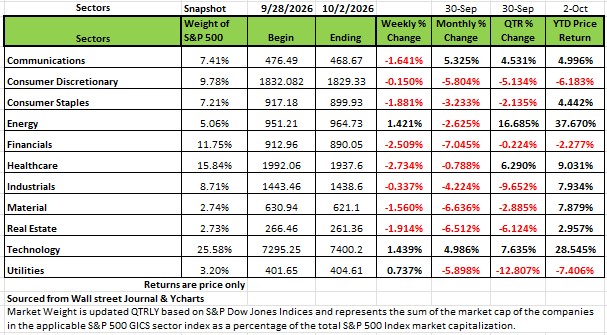
Eight of the 11 sectors that make up the S&P 500 experienced declines last week. Healthcare and Financial sectors had the largest percentage drops this week, falling -2.7% and -2.5%, respectively. Consumer staples and real estate shed -1.9% each while communication services and materials fell -1.6% each. Industrials and consumer discretionary also edged lower.
The decline in the healthcare sectors was led by Incyte (INCY) falling -6.9% on the week. The drop came even as Incyte and Mirum Pharmaceuticals said their Atebrioz tablet was approved by the US Food & Drug Administration to treat adult and pediatric patients aged 12 years and older with fibrodysplasia ossificans progressiva, a rare genetic disease in which bone forms in muscles, tendons, ligaments and other soft tissues, progressively restricting movements.
In the financial sector, Fidelity National Information Services (FIS) was one of the hardest-hit stocks this week, sliding -8.4%. Deutsche Bank cut its price target on the company from $45 per share to $40 while maintaining a hold rating.
McCormick (MKC) led the slide in consumer staples, falling -6.8%. The spice company's fiscal third-quarter results exceeded Wall Street's expectations but showed it faced volume weakness amid macroeconomic uncertainty. McCormick's near-term catalyst path is choppy as demand trends are yet to show meaningful signs of improvement amid concerns around cost inflation and the pending Unilever Foods (UL) transaction,.
Three sectors managed to buck the week's downward trajectory: Technology and energy rose +1.4% each and utilities edged higher. Synopsys (SNPS) was among the top gainers in the technology sector, climbing +15% on the week. The company forecasted fiscal 2027 revenue and adjusted earnings per share above analysts' estimates.
The energy sector's gains were led by Marathon Petroleum (MPC), which rose +7.3% on the week. Marathon's stock received increased price targets from analysts at TD Cowen as well as BMO Capital. TD Cowen now has a price target of $450 on the stock, up from $375, while BMO raised its price target on Marathon's stock to $455 from $365.
Earnings reports next week are expected from companies including PepsiCo (PEP), Delta Air Lines (DAL) and Constellation Brands (STZ).
Economic data will include the U.S. services purchasing managers index for September, consumer credit for August and the University of Michigan's preliminary consumer survey for October.
The Demand for Money
When everyone wants to borrow at once, lenders basically get to name their price. Economists often describe interest rates in simple terms: an interest rate is the price of money. Like any price, it rises when demand outpaces supply. Long-term Treasury yields are now at their highest levels in decades, and a client note from Citadel Securities argues the reason is not mainly inflation fear. The firm points to stronger US growth and competition for capital. To understand that view, it helps to look at the market from the lender's side.
The lender's question: who gets my money? Every dollar of savings, whether held by a pension fund, an insurer, a foreign central bank, or an individual investor, can be lent only once. The lender has to choose between borrowers, and each borrower is effectively bidding for the same pool of capital.
Today, three large borrowers are bidding at the same time. The US government is running large deficits and must sell more Treasuries to fund them. Corporations, led by the largest technology firms, are borrowing and spending heavily to build AI infrastructure. Earlier this year, Citadel noted that expected capital spending by the major cloud providers was rising about 38% year over year into 2027. That is quite significant. The third group of borrowers is households and businesses that borrow for mortgages, equipment, and expansion. When several large borrowers want capital together, lenders don't need to accept low rates. They can lend it to whoever pays the most for the risk.
(A note for the economically minded: in textbook economics, "demand for money" usually means the desire to hold cash. Here we mean the demand for borrowed money, which economists call the market for loanable funds.)
How the price gets set: The US Treasury is the benchmark borrower. It is considered the safest credit, so everyone else borrows at a spread above Treasury rates. A financially secure corporate bond (A-rated or higher) might pay the Treasury rate plus 1%, and a riskier company (below investment grade) might pay plus 3%. When Treasury yields rise, the cost of borrowing rises for the entire economy.
According to the Citadel company, nearly all of September's rise in the 10-year yield came from real yields, while inflation expectations stayed fairly steady. The real yield is the return after inflation, so it is the true price of money. Citadel links the higher real yields to fiscal easing, loose financial conditions, and heavy AI investment. In other words, lenders are not mainly asking for protection from inflation. They are charging more because so many borrowers want their money.
Yields versus coupons: two different numbers. A bond coupon is fixed when the bond is issued. It's the interest payment printed on the bond, and it never changes. A bond's yield is the return a buyer earns at today's market price, and it moves every day. The two are connected. When a borrower issues new debt, the coupon is set close to the prevailing yield, because lenders won't accept less than the market rate. So, rising yields mean new bonds carry higher coupons, and the government and companies pay more interest for the number of years before the bond matures.
Existing bonds can't change their coupons, so their prices adjust instead. Suppose you own a 10-year bond with a $1,000 face value and a 4% coupon, which pays $40 a year. If new 10-year bonds now pay 5%, no buyer will pay full price for your bond's $40 annual payment. If the current holder of that bond needs to sell, they need to drop the price to about $946. At that price, a new buyer earns the market's 5% yield. The interest rate plus the capital gain when it matures. That's why bond prices and yields move in opposite directions.
Why it matters beyond the bond market: Every investment competes for the same capital. When a risk-free Treasury pays a strong real return, stocks, real estate, and private businesses all have to offer more to attract money. Valuations reflect this directly. A business producing $5 a year in perpetuity is worth $62.50 at an 8% required return. At 9%, it's worth $55.56, an 11% drop with no change in earnings. Citadel itself noted earlier this year that higher long-end rates are again giving investors an alternative to equities.
There is an encouraging side to the growth-driven explanation. If borrowers are paying more because the economy is strong, some investment and spending can keep expanding despite higher rates, which weakens the usual braking effect of tighter money.
The other side of the argument: This is one firm's interpretation. Speed also matters: Citadel has said the economy can absorb higher yields as long as the selloff isn't dramatic. And government borrowing differs from corporate borrowing in one important way. Companies borrowing for AI expect a return on that investment, while deficit financing must be absorbed whatever its productivity. If the supply of Treasuries keeps growing, lenders may eventually require a larger premium just to keep buying.
Interest rates reflect competition for a limited pool of savings. Right now, Washington and corporate America are both bidding hard, and lenders are charging accordingly. For investors, that means higher coupons on new bonds, lower prices on old ones, and a higher hurdle for every other investment
Keep in mind that this isn't a shortage of money. It's a shortage of lenders of long-term money at the old price. Between the size of the U.S debt the continued annual deficit of $2 trillion, investors are concerned about lending money for such long period of time. Nearly $8 trillion sits in short-term funds, while about $3 trillion of new long-term borrowing competes for the investors who are willing to commit for longer. That gap is filled through price: higher real yields, a higher term premium, and wider spreads for the riskiest borrowers. The risk to watch is whether foreign demand keeps weakening while budget deficits stay high. If that happens, the long end has to rise further to attract enough domestic buyers.
The Week Ahead
The U.S. fixed income markets will get a test of the market’s appetite for longer-dated issues as the Treasury conducts its monthly auction for 10-year and 30-year notes on Wednesday and Thursday, respectively. The Bank of Japan will also be issuing 10-and 30-year JGBs next week, and investors will surely be keeping an eye on whether the blowout in spreads between French and German debt has the sort of aftermath of similar instances on European sovereign debt spread divergences. The minutes from the Fed’s September meeting will also be released on Wednesday and should provide additional insight into the policymakers’ views on dealing with still elevated
inflation.
The mega-cap techs seem least concerned with the rise in yields as the expectations of returns on their AI investments are overshadowing the elevated funding costs as a mere inconvenience. But behind the tech-dominated index numbers, there’s certainly a divergence between the chipmakers who have been the real-time beneficiaries of all the spending and the hyper-scalers who have tapped the credit markets to the tune of $220B this year. It’s the former who have driven the Nasdaq 100 to new highs while the latter group has lagged. One may think a little concern for the elevated levels is being expressed in the options market as well as the spread between implied volatility of 30-day Nasdaq 100 options (VXN) and S&P 500 options (VIX) reversed course from its steady narrowing since mid-June to widening out this past week. Of course, one also observes that this spread widened considerably when the chipmakers had their historic run during April and May.
This article is provided by Gene Witt of Optimized Capital LLC (A wealth management advisory Firm) for general informational purposes only. This information is not considered to be an offer to buy or sell any securities or investments. Investing involves the risk of loss and investors should be prepared to bear potential losses. Investments should only be made after thorough review with your investment advisor, considering all factors including personal goals, needs and risk tolerance. Optimized Capital is a registered investment adviser that maintains a principal place of business in the State of Illinois. The Firm may only transact business in those states in which it is notice filed or qualifies for a corresponding exemption from such requirements. For information about Optimized Capital’s registration status and business operations, please consult the Firm’s Form ADV disclosure documents.